

Six months ago, I had a view that coding agents would replace Excel.

This was informed by my own experience with my throughput expanding at Substrate. In hindsight, I was thinking too narrowly: coding agents will replace the entire office “suite” for a large majority of white collar workers.
By office suite I mean Microsoft Office and Google Workspace. Roughly these include:
Word processors: Microsoft Word, Google Docs - primarily a communication tool for prosaic/qualitative work
Spreadsheet programs: Microsoft Excel and Google Sheets - primarily a tool for analysis & quantitative work
Slides: Powerpoint, Google Slides and keynote - primarily a tool for persuasion and presentation
Chat: Slack, Teams - Primarily a tool for collaboration.
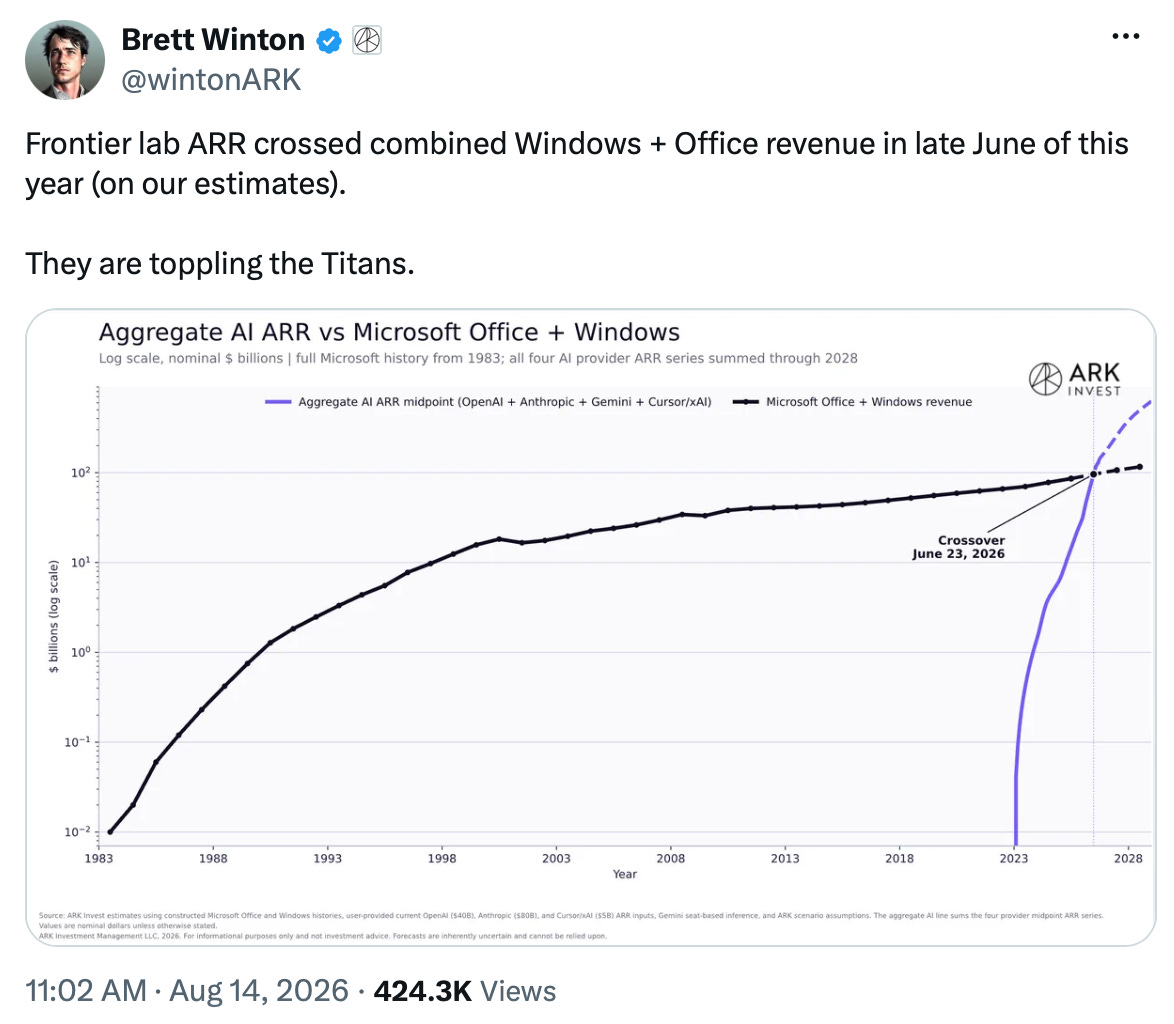
There’s a lot of other functionality bundled in like email (gmail), file sharing(dropbox) calendar etc, but the modern office worker is expected to be fluent in the above 3. Brett’s tweet here is a little hyperbolic because comparing all of ChatGPT revenue to Office & Windows is pretty apples <> oranges, but he’s directionally right; the world is finally coming around to the same conclusion:
Over the last six months:
Claude Cowork and similar tools have taken off. Many non engineers now routinely use coding agents. [1]
IDEs have become increasingly commonplace as a tool in white collar work because you can increasingly do very powerful things in natural language.
White collar workers of all stripes, from the very technical to the absolutely non technical, are finding that they can use code to get things done without actually having to understand the code (and often can just verify the results)
Lastly, all the major coding agent tools have a) shipped Cowork like capabilities, and b) have put a coding agent right next to their their “Cowork equivalent” as they’ve sold to enterprises. They’ve said “hey, your team’s not going to use Claude Code, please don’t look at it.” But what you see over and over again is people (non coders) try to do something, switch tabs, Claude Code writes a script for them, they realize that they can never give up such power. [4]
Coding agents have a) collapsed the entire office suite into a chat box with tools and b) enabled users to produce the same artifacts with natural language. If you can clearly describe what you want and have a way to validate the results, you can complete all the same tasks, and often better:
The average user can now analyze data in greater depth, with more range, and much more quickly than even the best excel jockey could by hand
The average user can generate a long, cogent document far more quickly in ChatGPT or Claude than by hand.
The average user can also design decks with far more polish than used to be possible by hand
The modern office suite might continue to exist primarily as endpoints / containers for artifacts, but creation will increasingly shift to LLM powered tools. It will be a long time before licenses/SAAS fees go away because of bundling [3]). Copilot and Gemini bundled in the respective office suites is a tacit admission that these things solve overlapping problems, and even then, Windows and Devices revenue fell $230M to $17.1B in FY2026 while the rest of Microsoft grew.
What’s still unclear
Meat proxies abound, for all with eyes to see [5]
In the past, it took real skill to create a long document that was cogent and coherent. If you read something that was long and well written and cogent and coherent, you could kind of assume that the writer knew what they were talking about. Now you can’t.
Same with Excel - you actually had to be good at analysis to create a model. In the industries and functions that are highly dependent on Excel for analysis, you could kind of assume that the person understood the thing that they were analyzing. And now you can’t.
This cuts both ways. There are amateurs who will produce analysis much more sophisticated with much more range than they could before, and that analysis will be correct. And there are people who will confidently produce bullshit and you will be unable to tell without an intense amount of review or without an adversarial coding agent doing the lookup for you. So we’ve gained an insane amount more throughput and at the same time lost trust and fidelity. This is a version of the perennial complaint of bots in social media, except now they are in the documents you consume professionally, upon which your professional output depends.
Pricing
The old office suite was license based at first and eventually SaaS. It was never consumption based. Both pricing models allowed unlimited creation/consumption once installed, without the employer having to think about surprise bills. In this new world, that dynamic is less true, so I anticipate one or more of 4 things will happen.
Enterprises will rate limit usage (this is already happening) until they’re measurably increasing enterprise value at a rate greater than token spend. This might happen by user or by very clearly delivering more value than the clients are spending on it. And that might be rate limited to like a certain group of people within an organization.
Token expenses will have to be sufficiently reliably low that CFOs can accurately model/predict associated costs
Enterprises will have to experience periodic blockbuster business outcomes that can be tied directly to token spend.
Seat based pricing will get a second lease on life: much has been written about the demise of seat based pricing, but I just don’t see CFOs underwriting variable spend for tools that 100% of the company will use.
Multiplayer
It doesnt feel like any frontier lab products or AI companies have really cracked the nut on collaboration. Slack and Teams remain the primary means for collaboration in most organizations I observe and interact with, and the functionality inside most IDEs and the frontier lab apps like ChatGPT and Claude continue to be designed primarily for single-player use. Not sure what this is, how it gets obviated, or if it even needs to. You can already see tools like Cyrus and Claude Tag trying different approaches to chip away at this. But because the atomic unit of value is primarily an interaction between two colleagues, it’s just hard to tell how this evolves.
Implications
From what I can tell, there are two major implications, first on work and then on workers:
On work, there are many types of assumptions that you used to be able to make based on the quality and polish of an artifact, that you no longer can make. An individual can produce many more than before, and they all require much more verification than they used to. You can probably use models for some of this, but at the end of the day, humans are responsible for organizational outcomes. No one will accept “Claude told me” as a reason for why you fat fingered earnings.
On workers, you can already see roles being redefined, where in particular technical roles that used to be adjacent to non-technical ones and vice versa will merge into a single function.
—
[1] The primary difference (to a user) between Cowork and Claude Code in the Claude app, other than the expected output being code, is that Cowork preloads skills and connectors for you, and Claude Code is much closer to the metal. The underlying model’s the same. I think what Cowork really did was make all those interactions into “Connectors” and make “Connectors” a first-class citizen with a GUI, access control, and so on.
[2] I don’t know a single product manager that isn’t spending some of their day in an IDE, even though their jobs aren’t explicitly to write code for the most part. And I’m seeing similar effects with go-to-market folks, operations, etc.
[3] All the office suites are bundled in some way, either sold as part of an overall package or bundled in the corporate org structure and given away for free. So I expect usage to shift far more quickly than the transactional metrics indicating that they have
[4] Anthropic did this first, and then OpenAI recently combined ChatGPT with Codex.
[5] From this very good piece: https://gruhn.me/blog/2026-08-03/