

When building something; a product, a system, or an object, I often have to remind myself that everything is a variable other than laws of nature.
When you’re at the start of something there are so many questions; are you working on the right problem? Is the problem valuable? To whom? Even if it is a valuable problem, will your solution be right? Will it even be good? Is there more than one right solution? Are you asking the right questions? Do you have the right inputs? Etc
To get around this, we often rely on prior art set by our predecessors; I call these defaults. Using defaults allows you to limit the number of variables you have to affect, or the number you’re trying to test or can afford to adjust in this round. In product or company development these will be the APIs or heuristics/assumptions that generally have worked before and are well documented. For example, if you’re building a consumer stock trading product, you can build the functionality on Alpaca and DriveWealth’s APIs, who have abstracted away the regulatory + technical interface for various exchanges like the NYSE and NASDAQ, instead of going directly to the exchanges. You can rely on Google Adwords for initial acquisition instead of building a new acquisition channel from scratch. You’d treat these as defaults and apply your creativity to the variable you’re exploiting (e.g. free options trading or prediction markets, whatever that is).
However, the tradeoff is that when you rely on prior art, you adopt prior constraints. This means living on top of technical decisions that preceded you, economic structures that were put in place before you, by different people with different incentives and payoffs, when different things were technically or regulatory possible. This limits the kinds of breakthroughs and inventions available to you.
Breakthroughs = Original + useful
One of the hardest things to do in product development is consistently building things that are both original and useful. The diagram that’s been in my head for a long time is:
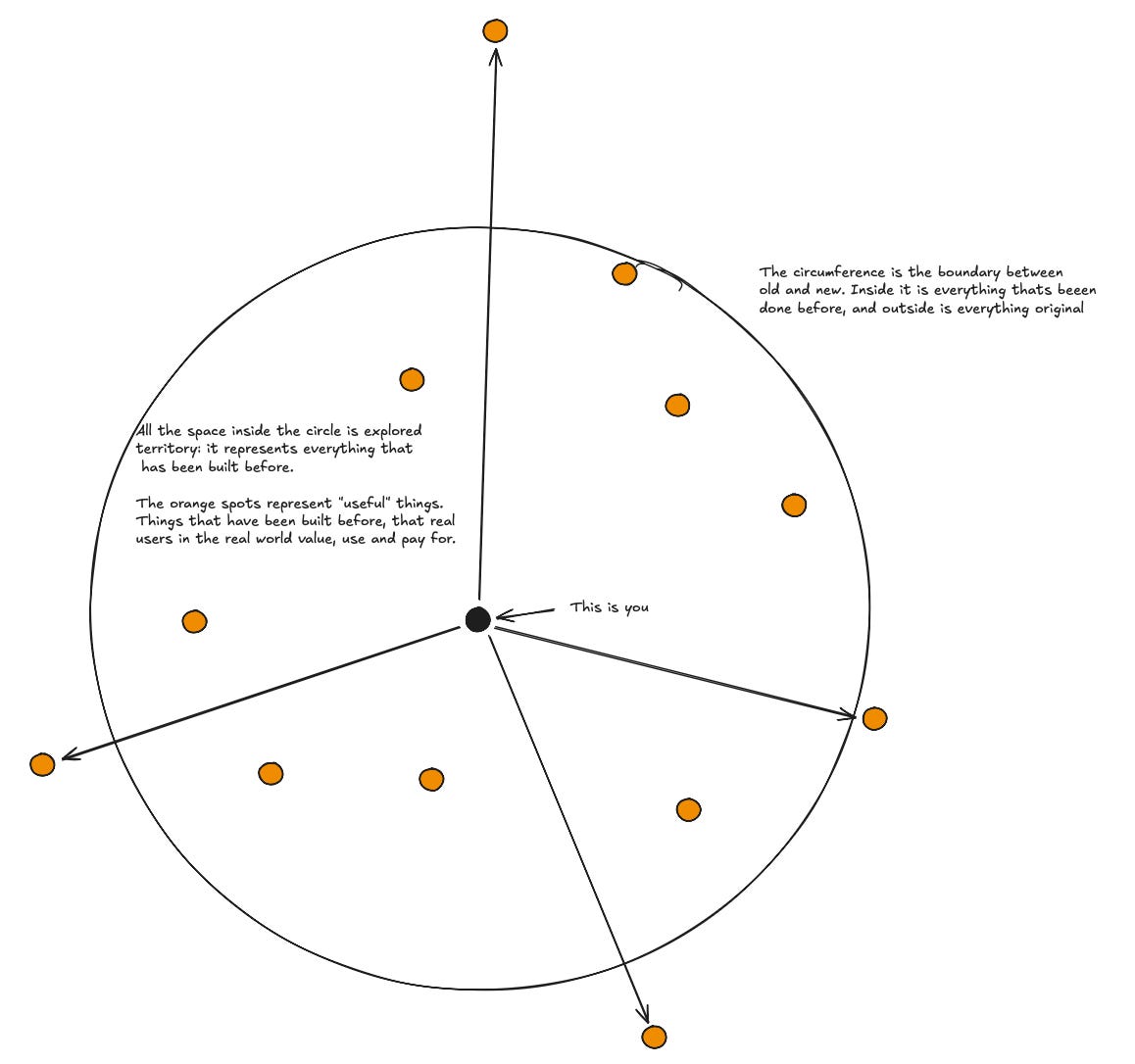
The way to read it is:
When building a new product, you start in the center. The interior of the circle is explored territory, including everything that’s been tried.
Most of the people with that problem today are already solving it somehow. They might not love that “how”. But they’re doing it. Those are the orange spots within the circle. They’re sparse because most attempts don’t result in something useful.
Breakthrough products require exiting the circle (building something original) AND landing on an orange spot outside it (that original product being actually more useful than what exists today). Most unexplored territory is just as barren as explored territory.[5]
To build something original (without regard to whether it’s useful), you just have to exit the circle. Build literally anything that hasn’t been built before, regardless of utility. An example of this is Humane[6]; they built something that hadn’t been built before and was thoroughly original. It just ultimately didn’t beat existing alternatives on utility (or beat them sufficiently enough to reach escape velocity).
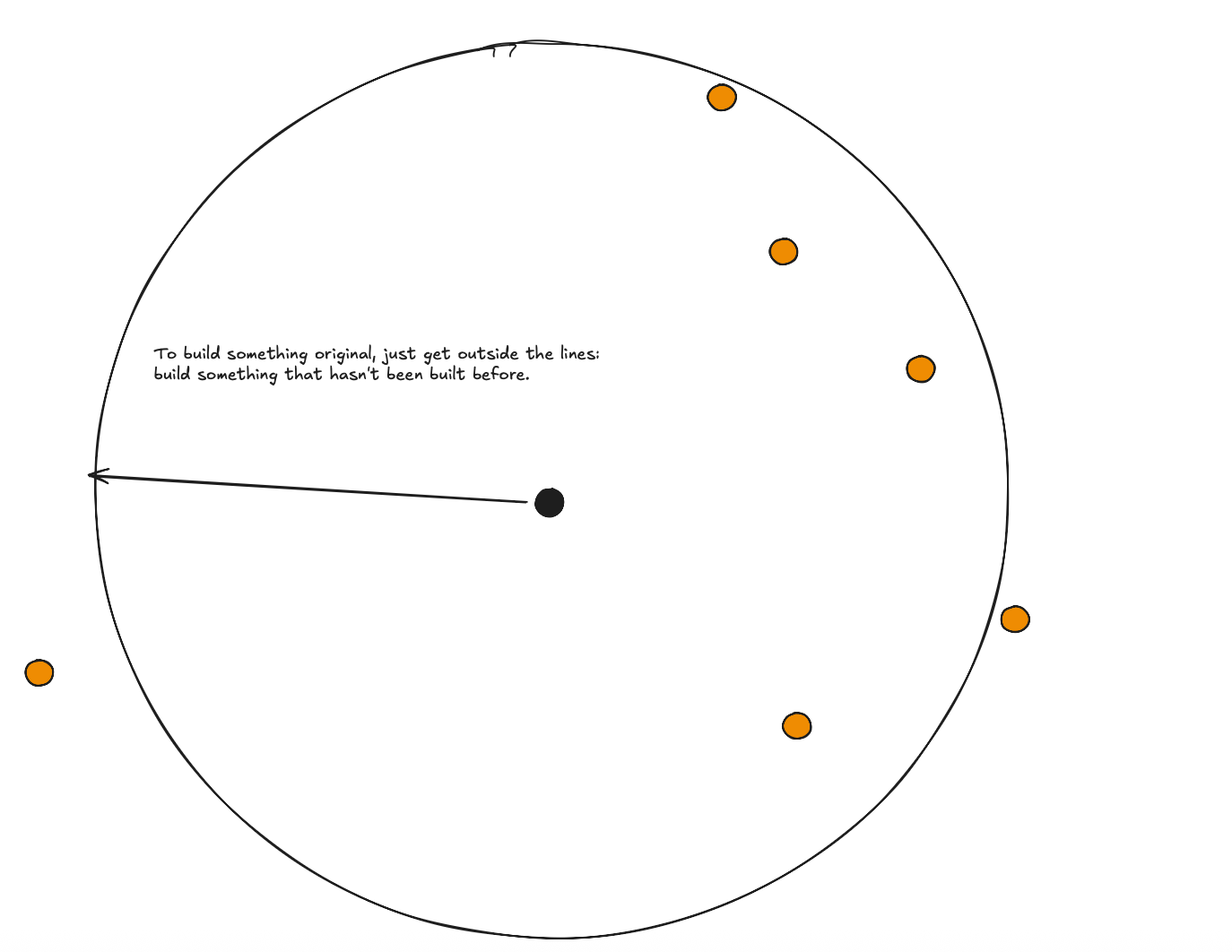
It’s also easy to build something useful; just copy what already exists (any of the orange spots inside the circle).
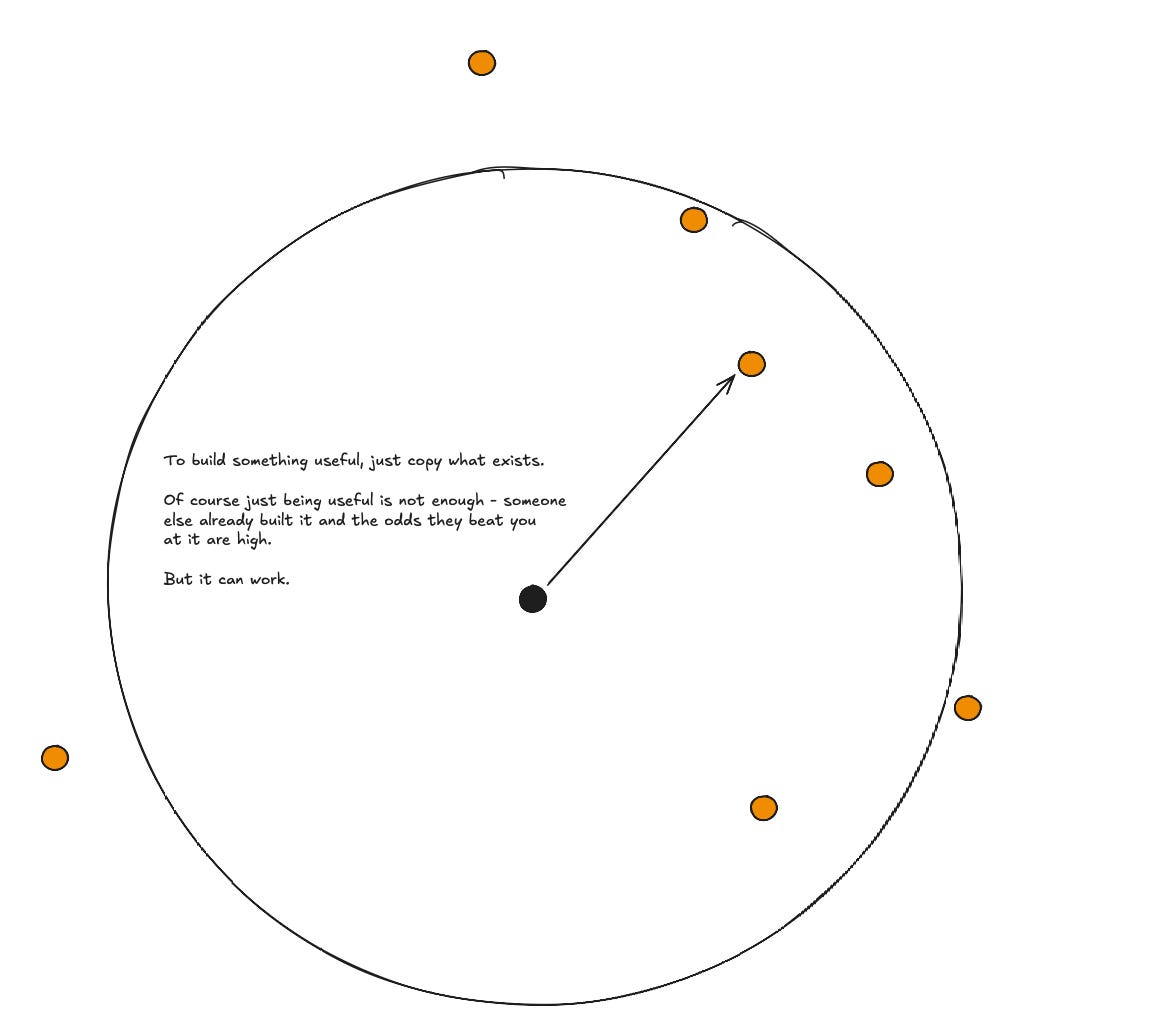
To get to a breakthrough you can imagine 2 paths
Conviction based, single shot
Iteration based, multi shot
To build something that breaks through enough that customers change their current habits in a single shot with no iteration, is incredibly difficult. You have to have conviction that what you’re building hasn’t been built before (so it’s outside the circle), and also solves a problem so much better than existing alternatives, that customers see it and switch fast enough to pay off the (often) enormous initial investment.
I don’t have a good frame for this (hitting the target in one shot) . I’ve seen it referred to as “taste”[1] in the past, and I have shipped a couple of products this way, but it’s emotionally and financially expensive to change so many variables thoughtfully, last long enough to synthesize and ship, AND last long enough to survive if you are wrong. This is why so many (including me) fall back to iteration all the time. I assume that most first shots will miss, and most of the time customers wont care about what I ship first. I focus instead on building the discipline and muscle to keep shipping original things quickly, with each subsequent iteration refining my intuition, reflecting my learning from past iterations, and increasing the odds we get there.

This way, you don’t get attached to a solution - you start with an opinion, and every subsequent iteration reflects that opinion seasoned by your learnings from the last iteration. Theoretically over time you should get closer and closer to the target. And simply because you’re trying and you’re out there, you’re learning and refining your understanding of the problem. Seeing what is useful is easier from the new point of originality (When users are trying and not liking your product, you’re out selling and it’s not resonating etc) than it is from your starting point in the middle of the circle.
Everything is a variable
The best way I’ve found to synthesize this is “Everything is a variable”, if you have enough:
Horizon or time scale; if you can sustain your effort for long enough, you can position yourself for something unorthodox that doesn’t yet exist, and wait long enough for the world to come to you
Resources: with enough money, you can turn knobs that others would consider frivolous, or economically incent others to change for you
Intent:. Think of this like persuasion or coercion or charisma or the “reality distortion field”; basically the combination of things that results in someone making what would otherwise be considered an irrational or suboptimal decision, on your behalf. [4]
What I mean by “a variable” is anything you can directly change. I’ve spent years working on complex systems in financial services and healthcare, and almost every time I peek behind the curtain, I realize I’m working with someone else’s defaults.
Viewed through this lens, everything but natural laws/laws of physics can be changed. In software this includes; language, database model, open source primitives, behavior paradigms, feedback loops, marketing, sales approach, and can even extend to things like partnerships and supply chain. The most original thing you can do is to change 100% of variables. This is super hard and has a high risk of wasting effort, because the existence of useful products is evidence that some percentage of existing variables are already toggled to the right settings to solve some user problems.
Artistry is understanding which variables, when changed, will have the highest differential impact on user/customer adoption (getting people to try it), behavior (retaining those people) and outcomes (delivering the utility for them)[2]. Leverage can be unlocking new (non-exhaustive list):
Utility: do something that couldn’t be done before
Lower cost: sustainably deliver the same outcomes for less cost
Speed: deliver the same outcomes faster
Precision: deliver higher quality outcomes
Aesthetic: create beauty, surprise or delight along an axis users care about
Changing more variables makes your product more original and compounds leverage if they all end up mattering to users. The risk is that only some matter but you spent resources to change all of them, thus reducing your return on investment. Applying massive change to a single variable can also be effective if you pick the right one.
How this came about
I first made this observation building the Cash Card in 2015. We designed a card a user would sign when opening an account, and tried working with several card manufacturers to bring it to life. We struck out for a while - it took almost 2 years to launch. In that time period we cycled through 5 banks, 6 card issuers and 7 factories across 5 card manufacturers. We took novel positions on everything from how it would be made, shipped, marketed, its regulatory positioning, the features customers would have, and how money would flow.
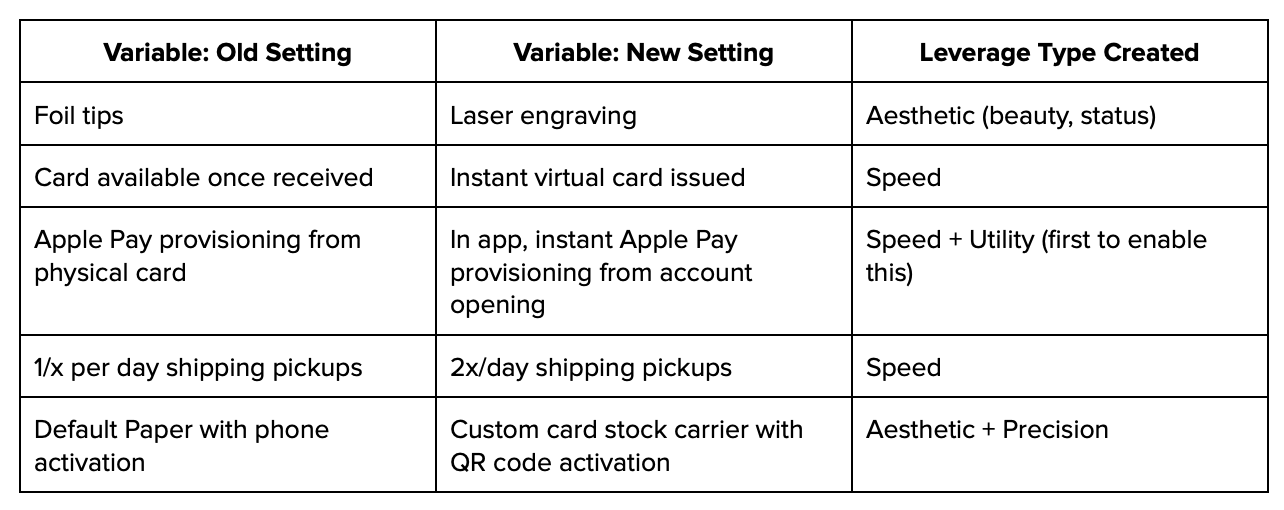
For example, the prevailing default card manufacturing & personalization method was foil tips (pressing foil in the shape of the design you wanted, onto the card with some heat application). The first drafts we got were super unsatisfactory, and our initial partners pretty much refused to try anything beyond off the shelf techniques, which drove underwhelming results.

Laser engraving (which we eventually shipped) was only used on a limited set of premium cards at the time (Chase Sapphire and Capital One Venture and JPM Platinum - all cases where the card stock was metal) and hadn’t been used the way we intended (as art). To launch, we changed a ton of variables from the defaults, initially focused on aesthetic leverage:
experimented with over 300 configurations of card construction, finish, overlays, laser positioning, angle, resolution, depth, intensity, and more. Initially, we didn’t even know these settings existed. It was only after several factory tours that this became clear.
Experimented with hundreds of paper, envelope, print and finishes for the carrier which optimized for everything from aesthetics to ensuring the QR code would print in the right resolution to ensuring the printer at the card manufacturer wouldn’t jam when running at high speed
Collaborated with our card personalization partner to procure new equipment so they could support our use case (remember at this time, no one believed the Cash Card would be huge - Square was sexy and Cash App had basically no name recognition).
Required our personalization partners to change their shipping pickups from 1 per day to 3 per day (and eventually settling at 2/day)
The variables we changed include; the plastic, the personalization, the paper, the envelope, the card activation, setting a PIN the design, the logistics etc (and this is only considering variables we changed in the physical world). We treated every single attribute of the product as a variable, and went unreasonably deep to explore the spectrum of settings we could turn each variable to (I’d have photos of this but we weren’t allowed phones/cameras on the factory floor, so you’ll just have to believe me).
We ended up catching a huge wave as the Cash Card took off and is now a massively scaled with over $1b in annual profit, but it’s rare that you get such a win in one shot (and in reality we started with loose product market fit, and iterated our way to tighter and tighter product market fit over the years by improving it’s usefulness. In this case, at the start, we used both horizon and intent; from when we started prototyping the Cash Card to when we shipped it took 2 years and we waited to get it right. The card manufacturers didn’t do what we needed because we paid them extra; it took a deep amount of engagement, belief, and persuasion to get them to do something unusual. We didn’t use resources - Cash App was extremely financially constrained at the time, so we couldn’t just pay partners or vendors to do what we wanted. They took risk and invested capital based on our vision & potential, not guaranteed returns.
One core risk with changing many variables at once; prior art/prior abstractions also are easy interfaces to other organizations. The more variables you change, the more expensive for you and your ecosystem to get things done. Suppliers and partners have preset ways to work with them. Sometimes a variable you want to change is in a partner’s control, and it’s not economically rational for one (or multiple partners to change in a synchronized way. The cost is more than just money; it’s opportunity cost they forgo by implementing your roadmap, and the risk that even after all that it might not work out, and they’ll be stuck having made an investment with no payoff. To do this, we had to find partners who had deep incentives to break from the norm (I only realized in hindsight that part of the reason our card partners leaned in was because they viewed it as a way to win market share if things worked out). In addition - we needed what I describe as “intent”; the combination of factors that resulted in them adopting this change with no guarantee they’d be directly compensated.
The second time I observed this effect was when we wanted even more original outcomes and went direct to materials providers to explore novel constructions of plastics, glass and metals. Many of these innovations eventually made it into consumers hands, and were possible because we now had scale. Iterating materials is an expensive process that would produce expensive, premium outputs. We had sufficient resources (to afford the upfront process) and scale (to manufacture enough that the cost was reasonable and have confidence we could distribute the outputs).
I saw the same pattern play out a few times at Carbon, and I’m now seeing the same pattern play out again at Substrate (which prompted me to try and codify my thinking here). We’re trying to build something that is both novel and useful - an AI native product that actually executes RCM tasks on behalf of a practice, and owns the outcomes of that task (in contrast to hybrid approaches where you hire or acquire an RCM operation or a team of humans, and try to automate away the humans in the loop)
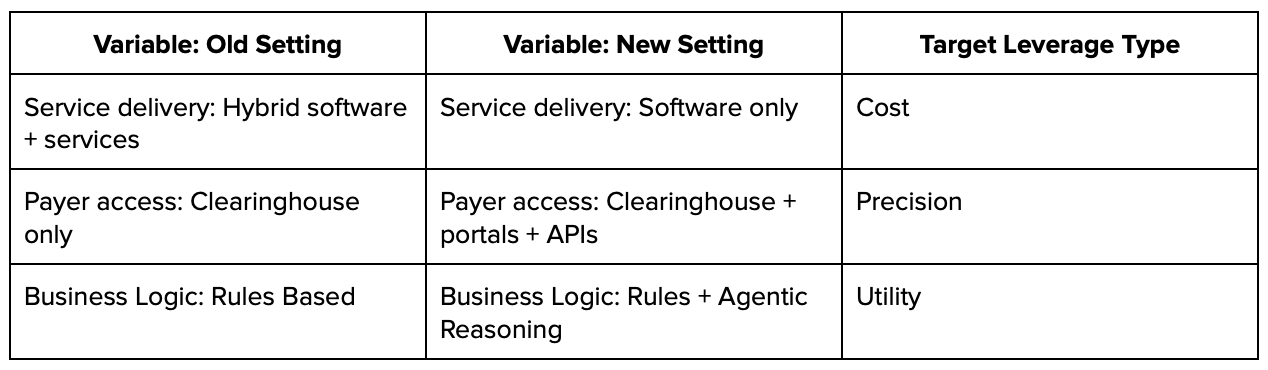
It’s novel because no one has succeeded at scale before doing what we do. The largest and most successful companies in RCM are hybrid services providers like R1 RCM and BPOs like Cognizant with tens of thousands of employees. These companies are insanely successful, have huge scale and massive onshore and offshore labor footprints. It’s useful because providers, practices, health systems and BPOs unequivocally want these outcomes and already spend heavily to achieve them. Doing them with technology only (vs. hybrid) means changing a LOT of variables, but can yield leverage in cost, speed, consistency, auditability and more, if we’re successful.
The pivotal question for us is: is it possible to deliver the business and operational outcomes healthcare providers already pay for, with technology alone? By the way - if you’re interested in this problem, we’re hiring.
Tesla is an example of applying massive change to almost every variable - they also make cars, but everything about them is different from the supply chain to the existence of self driving. [3]
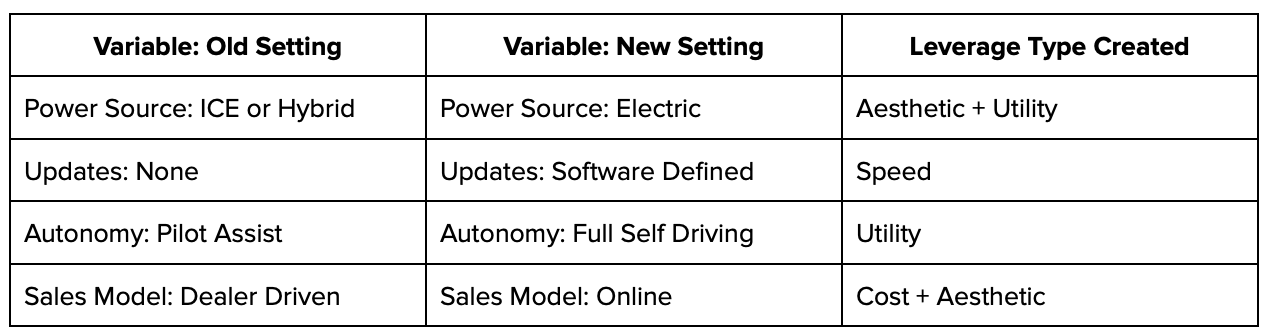
Massive change of many variables requires a long horizon, a lot of money and a massive amount of intent. Tesla embodies all 3.
Bringing it together
I wrote previously about Wave Hunting; how choosing to work on valuable problems is a force multiplier on execution. Even after you select a high quality problem to solve, it’s possible to miss macro shifts (technology adoption curves, regulatory changes, economic structure shifts) that multiply the returns on shifting certain variables in that problem space. Revisiting the Cash App example, the Durbin amendment capped interchange, but also it:
changed which customers banks could profitably serve, which
Reduced competition in certain acquisition channels, and
Made it possible to build a whole generation of financial products targeting those consumers (Cash App, Chime, Robinhood, Dave and many more all benefited deeply from this)
Wave hunting is about how the problems you choose to solve often drown how well you solve them. Thinking of everything as a variable is a reminder that once you’re focused on a problem, many things that people take for granted as fixed, can in fact be changed. Breakthrough products often require both.
Thanks to Nico Chinot for reading this in draft.
–
[1] Iteration and conviction based approaches are not inherently in conflict, they just have different tradeoffs. In both, you need to independently have an opinion/belief about how the world will be different from what came before. What differs is how much resources you risk. In iteration based approaches you inherently risk less in each round, but the potential payoff from a single round is relatively low, so you have to compound iterations over time. In conviction based approaches you basically can risk all your resources in a single round. If you’re right, the payoff is immense, but if you’re wrong, you don’t get more rounds.
[2] Just because everything can be changed, doesn’t mean everything should be. Trying to change everything can also be a sign of analysis paralysis, again because it’s just not likely that the best outcome available can only be achieved by changing every single variable.
[3] Unlike my other examples I’ve never worked at Tesla, so this example reflects my observations from the outside looking in.
[4] The narrowest way I can think of to describe this is persuasion - creating a suite of arguments so effective that the counterparty is convinced to do something that they would not have considered rational prior to the argument. The broadest is the “Reality Distortion Field” concept which is almost adjacent to religion; using some combination of factors to get large numbers of dispersed actors to buy into your cause and coordinate on your behalf.
[5] there’s a kind of breakthrough product that relies mostly on a marketing or branding innovation where what you’re doing is changing how people think or what people believe without really much change to the substance or utility of the product. I recognize these exist and I can’t really speak on them because I don’t understand them.
[6] This is not a knock on Humane. Building that product in that category takes a ton of courage. Breakthroughs are hard and most don’t work.
Awesome reflection. I can empathize across the board. Your post has me thinking - What about appetite for the change? In B2C, I’d argue it’s easier to be far ahead of the curve and change behavior with things like aesthetic, access, ease, etc. New adopters exist in this domain with more willingness, even at small percentages, to engage with something new or novel. In a B2B environment, the math gets a fair bit more complicated. Better, more intuitive UX? Great. Quicker access, fantastic? Post adoption, less cost? Where can I sign up! But there’s the less visible part, willingness to change at all. I don’t see it as unsolvable, (I’ve been working towards this for a while in the financial services space, so I believe it’s plausible) but that force, call it inertia or appetite, ends up being a big part of the adoption success.